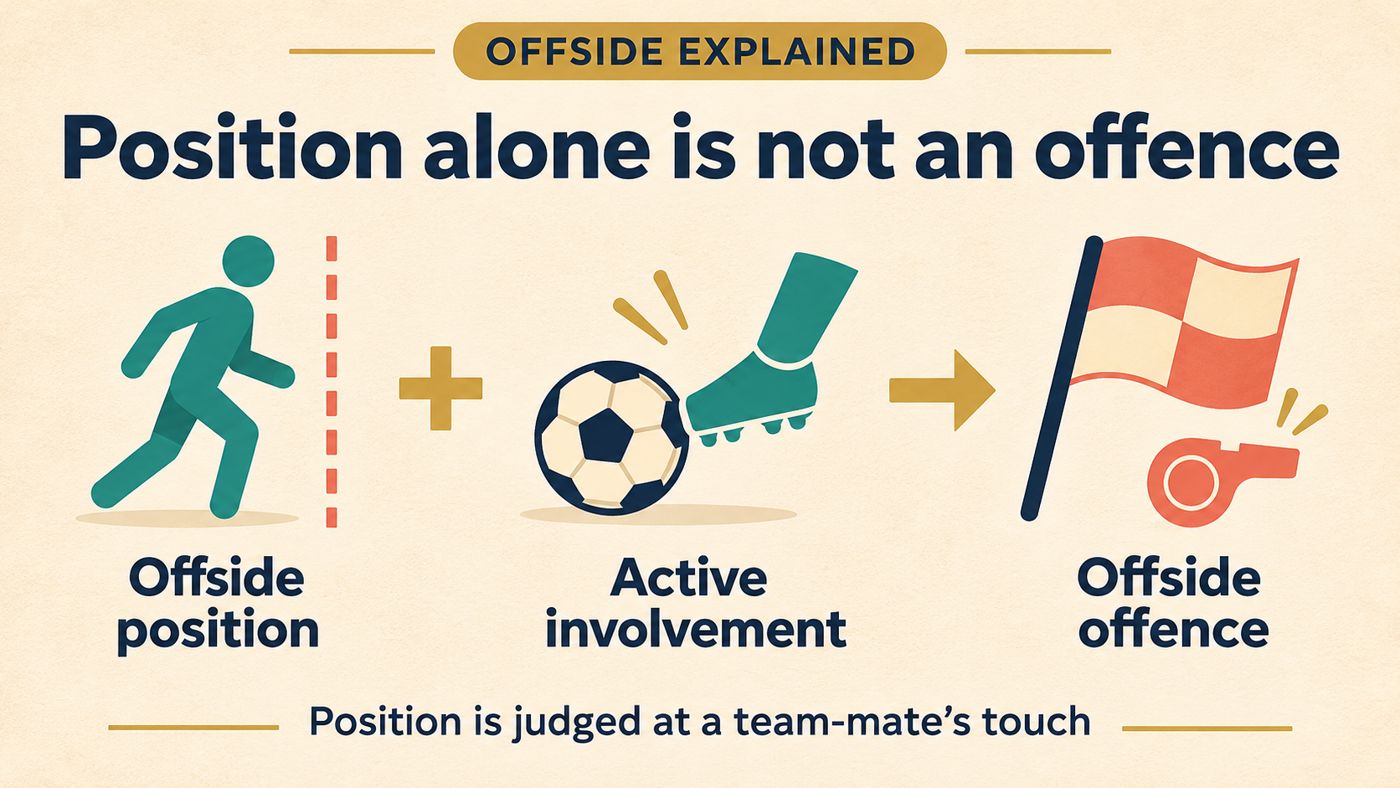
The flag goes up, the crowd groans, and the player who supposedly offended never touched the ball. If you've wondered how that works, the answer is in the wording of the law. Standing in an offside position is not an offence. The offence comes only when that player becomes involved in active play.
This explainer follows IFAB Law 11. Every scenario below is a hypothetical illustration, not a real match.
What counts as an offside position?
The law sets two tests. A player is in an offside position if any part of the head, body or feet is in the opponents' half (not counting the halfway line). Any part of the head, body or feet must also be nearer the opponents' goal line than both the ball and the second-last opponent.
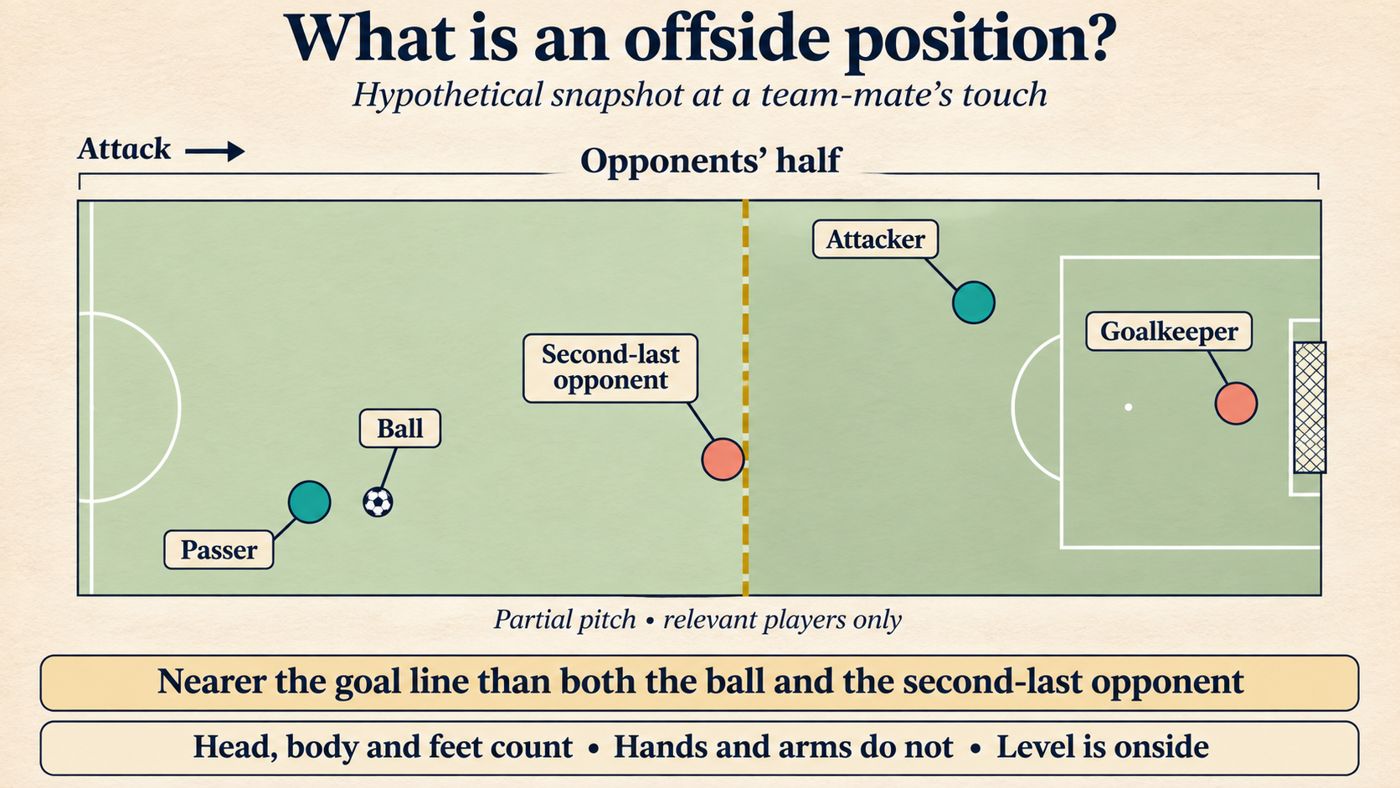
Hands and arms don't count, and that applies to goalkeepers too. For offside purposes, the upper boundary of the arm is in line with the bottom of the armpit.
Being level matters as well. A player level with the second-last opponent, or with the last two opponents, is not in an offside position.
Hypothetical example: None of an attacker's head, body or feet extends beyond the second-last opponent; only an outstretched arm does. The arm is ignored, so the attacker is not in an offside position.
When does position become an offence?
The moment of the pass is what counts. A player in an offside position when a team-mate plays or touches the ball is penalised only on becoming involved in active play. The law lists two broad ways that happens.
- Interfering with play: playing or touching a ball passed or touched by a team-mate.
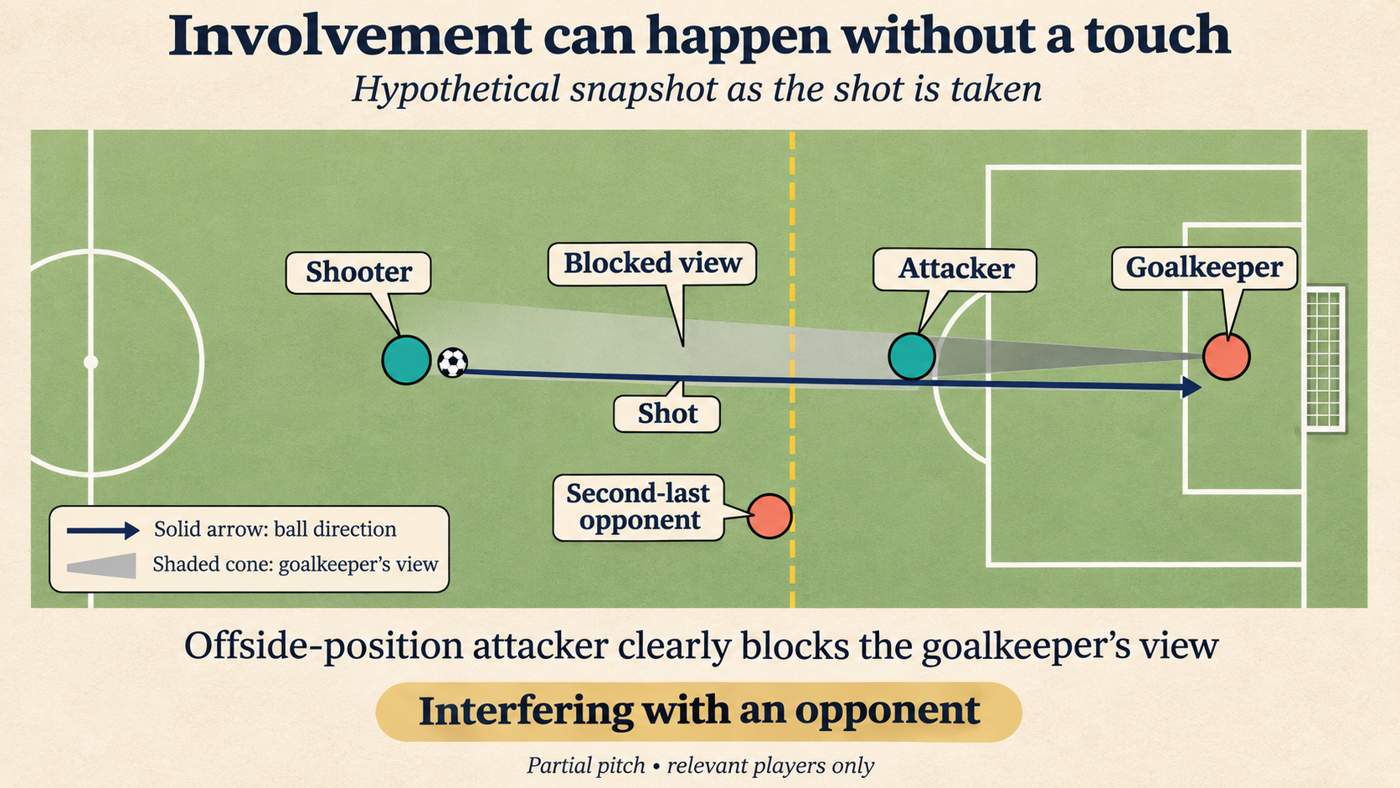
- Interfering with an opponent: this covers several actions, listed below.
The law's examples of interfering with an opponent:
- clearly obstructing the opponent's line of vision
- challenging for the ball
- clearly attempting to play a nearby ball when this impacts an opponent
- making an obvious action that clearly impacts the opponent's ability to play the ball
There is also a separate route: gaining an advantage by playing the ball or interfering with an opponent after the ball has rebounded or been deflected off the post, crossbar, a match official or an opponent. The same applies after a deliberate save by an opponent.
Hypothetical example A: A striker is ahead of the ball and the second-last defender when a team-mate passes. The striker lets the ball run past, and another team-mate who was onside collects it. The striker did nothing to affect play or any opponent, so under the law there is no offence.
Hypothetical example B: The same striker, still in an offside position, runs onto the pass and takes a touch. That is interfering with play, so offside is given.
Hypothetical example C: The striker doesn't touch the ball but stands in front of the goalkeeper and clearly blocks the keeper's view of a shot. That is interfering with an opponent through obstruction of the line of vision, so it can be penalised.
Which situations catch fans out?
The trickiest cases involve a defender's touch. If a player in an offside position receives the ball from an opponent who deliberately played it, the law says they have not gained an advantage. The exception is a deliberate save.
The law defines deliberate play as having control of the ball with the possibility of passing, gaining possession or clearing it. A poor or unsuccessful attempt doesn't change that. Indicators of control include:
- the ball travelled from distance and the player had a clear view
- the ball wasn't moving quickly
- its direction wasn't unexpected
- the player had time to coordinate their body movement, rather than stretching or jumping by instinct
The law adds that a ball on the ground is easier to play than one in the air.
Hypothetical example D: A defender has time and a clear view of a slow, rolling ball and attempts a clearance, but slices it straight to an attacker in an offside position. The defender deliberately played the ball, so the attacker is not considered to have gained an advantage.
Hypothetical example E: A shot hits the crossbar and rebounds to an attacker who was in an offside position when the shot was taken. A rebound off the woodwork is listed in the law, so the attacker can be penalised for gaining an advantage.
Timing also has a detail. The first point of contact of the team-mate's play or touch is used. The exception is a ball thrown by the goalkeeper, where the last point of contact is used.
When is there no offence, and what happens if there is?
There is no offside offence if a player receives the ball directly from a goal kick, a throw-in or a corner kick.
When offside is given, the referee awards an indirect free kick where the offence occurred. That includes a spot in the player's own half.
Fouls can interact with offside. If a player in an offside position is moving towards the ball to play it and is fouled before playing, attempting to play, or challenging for the ball, the foul is penalised because it came first. If instead the player is already playing, attempting to play, or challenging for the ball when an offence is committed against them, offside is penalised because it came first.
A player who moves into an opponent's path and blocks them is dealt with under Law 12, not as offside.
The law also covers defenders who leave the pitch without permission. They are treated as being on the goal line or touchline for offside purposes until the next stoppage, or until the defending team has played the ball towards the halfway line and it is outside its penalty area. If the player left deliberately, they must be cautioned when the ball is next out of play.
A quick test for the next flag
- Was the player in an offside position when the ball was played? Remember that head, body and feet count, and arms don't.
- Did that player then touch the ball or affect an opponent?
- Was the ball deliberately played by a defender, or did it rebound or deflect?
- Did it come from a goal kick, throw-in or corner?
This is a simplified reading of the text. Match officials apply the full law and its wording, so check the current Law 11 page for the definitive version, as the Laws can be revised.
 Economy & Finance